
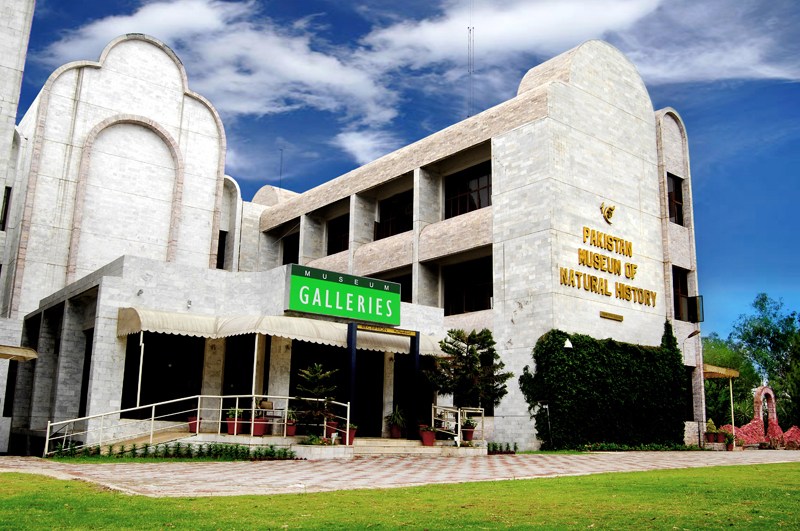
The Pakistan Museum of Natural History has four divisions namely Botanical Sciences, Earth Sciences, Zoological Sciences and Public Services. The first three divisions are engaged in the collection, preservation, identification and research activities pertaining to plants, fossils & minerals and animals resources of Pakistan respectively, while the latter is responsible for mass education and popularization of the natural history through various displays, exhibits and dioramas.
The Botanical Sciences Division is one of three Science Divisions at the PMNH that deal with plants – their collection, preservation, and identification in the lab/herbarium, as well as their management and conservation in the field. The references collection are sub-divided into three herbaria including, Algarium (collection of algal sample) Fungarium (Mushrooms specimens) Plant Herbarium with approximately 1.15 million specimens. Collections consist of Natural specimens from all over Pakistan and are increasing day by day. For researchers/scientists from all around the country, this historical and highly valuable scientific collection is the only source of basic and applied sciences research. Botanical Science Division also provides guidance and assistance to researchers, students, and other interested individuals and organisations in the proper identification, management, and utilization of Pakistan's Flora, as well as educating the general public about the importance of plants and potential threats to Plant Biodiversity.
Earth Sciences Division (ESD) is one of the four divisions of Pakistan Museum of Natural History (PMNH) with the mandate to build reference collection of Igneous, Sedimentary and Metamorphic rocks, fossils (Vertebrate and Invertebrate) and minerals found in Pakistan for the purpose of identification, research and public education. Scientists in this division are engaged in building up comprehensive paleontological, anthropological and geological reference collection.
Regular field expeditions are being organized by the ESD scientists in the different regions of Punjab, Khyber Pakthtunkhwa, Balochistan and Sindh to explore natural wealth of Pakistan. These expeditions are the result of joint ventures at national and international level. Repository of ESD contains specimens of all three types of rocks, vertebrate and invertebrate fossils, minerals and gemstones available for the research and education. Geologists/Paleontologists of ESD carried out extensive field works in the last 40 years for the collection of rocks, fossils and minerals data from the different areas of Pakistan e.g. Potwar Plateau, Salt Range, Hazara area, Kala Chitta Range, Balochistan, Districts Swat, including lower and upper Swat, Mohammad Agency, Bajaur Agency/Malakand Agency, Northern Areas, (Gilgit-Baltistan), Yasin Valley, Ashkuman valley, Gupis-Gakuch, Hunza Valley up to Khunjrab, Chitral (Shishi valley up to Madaglasht), Gilgit, District Kohistan, Besham-Jijal-Duban-Patan (All along KKH), Part of Darel, Tangi valleys, Kaghan area (along Kaghan-Kohistan water-shed) and District Mansehra. As a result of these widespread excursions, ESD reference collection is quite rich in rocks, minerals, vertebrate and invertebrate specimens.
Scientists of ESD, since 1976, are collaborating with many international research organizations, institutes and academia and have completed many international research projects for biostratigraphical, sedimentological, faunal and geological/paleontological studies in association with Peabody Museum, Harvard University, Cambridge, Massachusetts, USA, University of Arizona, Tucson, USA, Northeastren Ohion University, College of Medicine, Rootstown, Ohio, USA, Howard University, College of Medicine, Washington D.C. USA, American Museum of Natural History, New York, USA, Swiss Federal Institute of Technology, Switzerland, Montpellier University, France, and University of Zurich (PIMUZ), Switzerland. Discovery of world largest mammal (Rhino) fossils “Baluchitherium” is also credited on account of joint international collaboration between ESD, PMNH and Montpellier University, France in the area of Dera Bugti, Balochistan.
For educational activities, the Earth Sciences Division provided assistance in preparation of educational exhibits, displays and dioramas for the general public, students and teachers for creating awarness about natural history of different areas of Pakistan. Many exhibits/galleries of ESD are excellently providing information about different types of rocks sequences, minerals, fossils, evolution of life with respect to geological time and Gemstones industry in Pakistan.
ZSD scientists are engaged in exploration, collection, preservation, identification and documentation of faunistic wealth of Pakistan. Huge collection of animals including insects, mollusks, fish, amphibians, reptiles, birds and mammals have already been added in ZSD reference collection for further exploitation in applied research. The Division conducts research in zoogeography and biodiversity with special reference to the impact of environmental degradation.
ZSD provides advisory/consultancy services to different organizations in conservation of wildlife and ecosystem rehabilitation. The Division helps in preparation of dioramas, exhibits, pamphlets and posters related to zoological sciences. It also imparts training in taxidermy, preservation and curation. The scientists working in this Division are mostly foreign trained and highly qualified. They published three books and over 180 research articles in national and international journals. The Division organized an International biodiversity expedition “ Hunza-2000” in collaboration with University of Oxford, UK and Florida Museum of Natural History, USA to document high altitude biodiversity and ecology of Northern Areas. The Expedition represented the most comprehensive biological survey ever undertaken in the high altitudes. The Expedition was an extension of seven years long research collaboration on butterflies between Pakistan Museum of Natural History and Oxford University Natural History Museum. The Expedition not only helped in extending knowledge of Himalayan-Karakoram biodiversity but also provided baseline data for the future assessment of environmental changes.
Research |
It's research is predominately focused on systematics and biodiversity. |
Entomological collections: |
A large number of specimens are housed in the insect repository of PMNH. The dry specimens are kept in specially prepared drawers placed in a number of cabinets. A part of insect collection has also been kept in jars or vials as wet preservation. All the collected specimens are properly labeled with such information like collection date, locality and collector's name while associated field data has been recorded in relevant catalogue register. This information helps in further research activities like proper identification of a specimen and preparation of a research articles/reports. |
Invertebrate collections (Other than insects): |
A large number of invertebrate specimens have been preserved at PMNH. These Invertebrates are collected from variety of habitat, ranging from terrestrial to aquatic and marine environment. These specimens are properly preserved, catalogued and have been studied by the researchers investigating the invertebrate zoology of the region. |
Vertebrate Collections |
Fish (Ichthyological) Section: |
The ichthyology section of ZSD houses a large number of specimens collected from all over the aquatic habitat of Pakistan including freshwater, estuarine and marine waters. They are properly preserved, catalogued and are used in different educational and research activities by the researcher, scientists and students. |
Amphibians and reptiles collections |
A lot number of specimens of amphibian and reptiles have been collected by ZSD scientists across Pakistan. Several new species have been described from Pakistan and are housed as TYPE specimens. All the collected specimens are properly preserved and catalogued. |
Birds' repository |
The birds' repository of ZSD is very rich having a large number of specimens of resident and migratory birds. These are properly catalogued and preserved in the form of stuffed specimens or as a study skin. |
Mammals Section |
The habitat of Pakistan is very rich that supports large number of mammals ranging from high altitude animals like snow-leopard, brown bear, the whale (not often) and dolphins that are found in the Arabian sea of Pakistani coast. Markhor (Capra falconeri) is the national animal of Pakistan. The section of mammals is divided into two groups, small and large mammals. All the mammals are preserved at the repository in the form of stuffed or skinned animals. Taxidermy section of ZSD is responsible for the preparation of stuffed animals and study skins. The mammalian collections and taxidermy activities are used for the education, research and conservation purposes. |
PSD is involved in public educational aspects of Pakistan Museum of Natural History. The scientific information and research is made understandable to general public through fascinating exhibits and displays. This Division is responsible for preparation and designing of PMNH science publications such as books, pamphlets and brochure. To carry out its varied activities, the Division has been divided into different sections such as Design and Drawing, Photographic, Model Making, Education and Public Awareness. All these sections have highly qualified staff that work in complete coordination.This Division also provides services to other scientific organizations for developing exhibits/displays. PSD organizes student trips, scientific lectures and film shows within and outside PMNH. Its Information Technology (IT) section maintains the PMNH databases and communication infrastructure.
|